Shed Base Size Calculator
A 10 by 12 ft floor plus a 1 ft border is a 12.00 by 14.00 ft pad: 2.07 cubic yards and 3.36 short tons at 4 inches and 1,920 kg/m³.
Last updated . 1,920 kg/m³ is the same start as the rectangular shed foundation tool: 1.62 short tons, 3236.27 lb, and 1.47 tonnes per cubic yard. A border of 0 reproduces that page’s 1.48 cubic yards and 2.40 short tons.
Volume for a circle, triangle, or polygon shed is the gravel shed foundation calculator. Dense base under the pad can also be figured as 304.
Shed pad size
The border is added on every side, so the pad grows by twice this distance.
Same rectangular start as the shed foundation page: 1,920 kg/m³. Border 0 is that page’s 10 by 12 result.
Pad size and gravel
—
Cubic yards
0.00
Cubic feet
0.00
Cubic meters
0.00
Short tons
0.00
Tonnes
0.00
Floor size and pad size
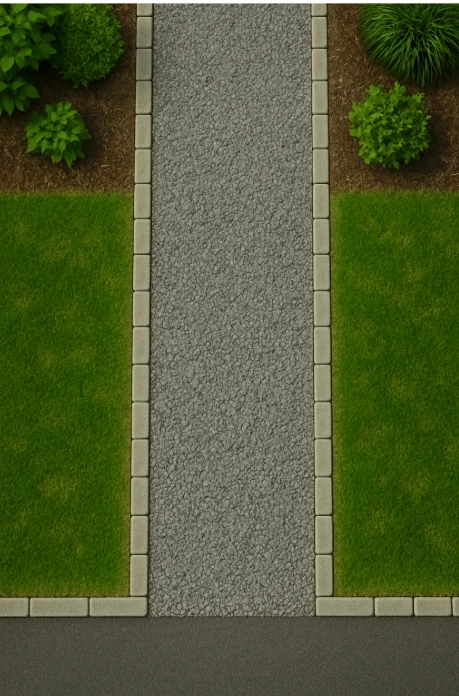
The foundation calculator asks for the gravel rectangle. This one asks for the shed floor, then adds a border on every side. Pad length = floor length + 2 × border. Pad width = floor width + 2 × border. The default 10 by 12 with a 1 ft border is 12 by 14.
| Floor | Border each side | Pad | 4 in at 1,920 kg/m³ |
|---|---|---|---|
| 10×12 ft | 0 | 10.00×12.00 ft | 1.48 yd³, 2.40 short tons, 2.17 tonnes, 1.13 m³ |
| 10×12 ft | 6 in | 11.00×13.00 ft | 1.77 yd³, 2.86 short tons, 2.59 tonnes |
| 10×12 ft | 1 ft | 12.00×14.00 ft | 2.07 yd³, 3.36 short tons, 3.04 tonnes |
The zero-border row is the foundation page’s worked example, so the two tools agree. The 6 inch row is the 11 by 13 pad that page describes without a yard total.
Weight
One cubic yard at 1,920 kg/m³ is 1.62 short tons and 1.47 tonnes. The 12 by 14 pad is 56.00 cubic feet and 1.59 cubic meters. No extra percent is added for compaction. Circles and other polygons are still measured on the foundation page, where the triangle and polygon densities open at 1,600 until you change them. Gravel versus a concrete slab of this pad, including frost, is the shed base guide.
Worked example
Leave the floor at 10 ft by 12 ft, the border at 1 ft, the depth at 4 in, and the density at 1920. The pad line reads 12.00 ft by 14.00 ft (3.66 m by 4.27 m). Cubic yards read 2.07. Cubic feet read 56.00. Cubic meters read 1.59. Short tons read 3.36. Tonnes read 3.04. The formula line starts “Floor 10.00 ft by 12.00 ft plus 1.00 ft of border on each side is a 12.00 by 14.00 ft pad (3.66 m by 4.27 m).”
Frequently asked questions
What size pad does a 10 by 12 shed need?
The floor is 10 by 12 ft. One foot of border on every side makes the gravel pad 12.00 by 14.00 ft (3.66 m by 4.27 m). At 4 inches and 1,920 kg/m³ the pad is 2.07 cubic yards, 56.00 cubic feet, 1.59 cubic meters, 3.36 short tons, and 3.04 tonnes. The border is added twice: 10 + 2 = 12 and 12 + 2 = 14.
How does this differ from the shed foundation calculator?
The gravel shed foundation calculator is the volume of the shape you type. Its 10 by 12 ft rectangle at 4 inches and 1,920 kg/m³ is 1.48 cubic yards, 2.40 short tons, 2.17 tonnes, and 1.13 cubic meters. Set the border here to 0 and this page matches those four numbers on a 10.00 by 12.00 ft pad. Circles and polygons stay on the foundation page.
How much does a yard of shed-base gravel weigh?
Both rectangular tools start at 1,920 kg/m³. One cubic yard is 1.62 short tons, 3236.27 lb, and 1.47 tonnes. One short ton is 0.62 cubic yards. The foundation page also describes 1.92 tonnes per cubic meter at that density. Per cubic yard the tonne line is 1.47, not 1.92. The triangle and polygon tools on the foundation page still open at 1,600 kg/m³.
What is a 6 inch border on a 10 by 12?
The foundation page says a 6 inch border turns a 10 by 12 floor into an 11 by 13 pad. Set the border to 6 and the unit to inches. The pad line reads 11.00 ft by 13.00 ft. At 4 inches and 1,920 kg/m³ the gravel is 1.77 cubic yards, 47.67 cubic feet, 1.35 cubic meters, 2.86 short tons, and 2.59 tonnes.
Does the tool add compaction?
No. The 4 inch depth is the depth you typed, and the tons match that volume at 1,920 kg/m³. The 304 page’s note about ordering about 10 percent extra loose stone is not folded in, so a zero border can match the foundation page exactly. Add the extra yourself if the quarry sells loose stone for a compacted finish.
How deep should the gravel be?
Four inches is the default, the same depth as the 10 by 12 row on the foundation page. A heavier building may want 6 inches. Change the depth and both the yards and the tons move. The pad size in feet does not change when only the depth changes.
Can I enter the floor in meters?
Yes. Length, width, border, and depth each have a unit menu. The formula line converts the pad back to feet and also prints meters. The 12.00 by 14.00 ft result is the default left in feet: 10 ft, 12 ft, and a 1 ft border.