No. 2 Gravel Calculator
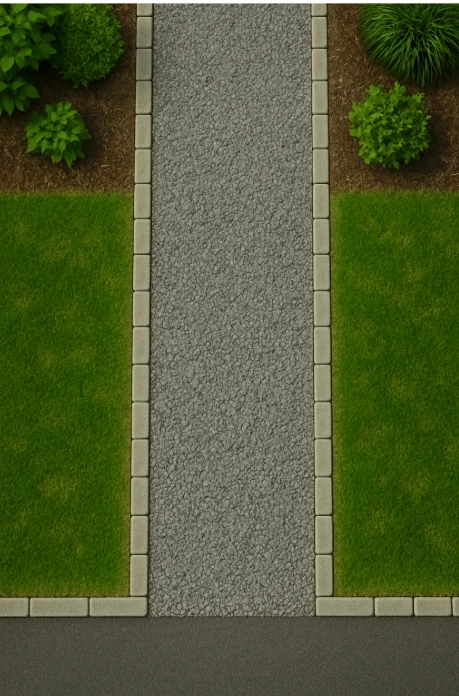
A 20 ft by 4 ft strip at 12 inches is 2.96 cubic yards and 3.75 short tons of No. 2 stone at 1,500 kg/m³.
Last updated . 1,500 kg/m³ is a planning assumption for open-graded No. 2, lighter than Caterpillar’s loose crushed stone row of 1,600 kg/m³. It is 1.26 short tons, 2528.33 lb, and 1.15 tonnes per cubic yard. Type the quarry number when you have one.
Size No. 2 is the large stone, not a 2 inch depth and not #57. Smaller 1 inch stone is on the 1 inch gravel calculator.
No. 2 stone
Planning assumption: 1,500 kg/m³ for open-graded No. 2. Caterpillar lists loose crushed stone at 1,600. Type 1600 if that matches the ticket.
Volume and weight
Finished cubic yards
0.00
Order cubic yards
0.00
Order short tons
0.00
Order tonnes
0.00
What size is No. 2 gravel?
ASTM D448 and AASHTO M 43 call this Size No. 2. The nominal size is 63 to 37.5 mm, which is 2-1/2 to 1-1/2 inches. The sieve bounds used for planning are 100 percent passing 3 inches, 90–100 percent passing 2.5 inches, 35–70 percent passing 2 inches, 0–15 percent passing 1.5 inches, and 0–5 percent passing 3/4 inch. That is the size of the rock, not the thickness of the layer. #57 is a different size, about 1/2 to 1 inch.
| Sieve | Percent passing |
|---|---|
| 3 in (75 mm) | 100 |
| 2.5 in (63 mm) | 90–100 |
| 2 in (50 mm) | 35–70 |
| 1.5 in (37.5 mm) | 0–15 |
| 3/4 in (19 mm) | 0–5 |
Those bounds are the standard size description, not a copy of the full ASTM table. ICPI has specified No. 2 as the open-graded subbase under permeable pavers, including in the August 2007 Interlocking Concrete Pavement Magazine. A dense driveway base is 304 or 411, not No. 2.
Weight per cubic yard
Caterpillar’s earthwork table lists loose crushed stone at 1,600 kg/m³ and 2,700 lb per cubic yard. No. 2 has larger voids than that mixed crushed stone, so this page starts at 1,500 kg/m³. One yard at 1,500 is 1.26 short tons, 2528.33 lb, and 1.15 tonnes. One short ton is 0.79 cubic yards. The same 1,500 kg/m³ is the decomposed granite and landscape-rock start. The rock is not the same product. Only the planning density matches. Replace 1500 with the supplier’s number, or with 1600, and the ton line follows.
Coverage
One cubic yard covers 27 square feet at 12 inches, 54 at 6 inches, and 108 at 3 inches. The filled example is 20 × 4 = 80 square feet at 12 inches, and 80 ÷ 27 = 2.96 cubic yards. Order yards match finished yards because the allowance is 0.
Worked example
Leave length at 20 ft, width at 4 ft, depth at 12 in, and density at 1500. Finished cubic yards read 2.96. Order cubic yards read 2.96. Order short tons read 3.75. Order tonnes read 3.40. The formula line reads 80.00 ft³ finished = 2.96 yd³ = 2.27 m³, then allowance 0.00 percent, and 3.75 short tons at 1500 kg/m³.
Frequently asked questions
What is #2 gravel?
ASTM D448 and AASHTO M 43 Size No. 2 is an open-graded crushed stone with a nominal size of 2-1/2 to 1-1/2 inches (about 63 to 37.5 mm). The bounding sieves are 100 percent passing 3 inches, 90–100 percent passing 2.5 inches, 35–70 percent passing 2 inches, 0–15 percent passing 1.5 inches, and 0–5 percent passing 3/4 inch. It is not a 2 inch depth. Depth is whatever you type. The Interlocking Concrete Pavement Institute has used No. 2 as a permeable-pavement subbase.
How much does a yard of #2 gravel weigh?
This calculator starts at 1,500 kg/m³, a planning assumption set under Caterpillar’s loose crushed-stone figure of 1,600 kg/m³ because open-graded No. 2 has more voids. At 1,500, one cubic yard is 1.26 short tons, 2528.33 lb, and 1.15 tonnes. One short ton is 0.79 cubic yards. Type 1600 if you want the clean-stone start used on the #57 page, which is 1.35 short tons per yard.
How much #2 stone for a 20 by 4 foot strip at 12 inches?
Leave the boxes as they open. The strip is 80.00 cubic feet, 2.96 cubic yards, and 2.27 cubic meters. At 1,500 kg/m³ the order is 3.75 short tons and 3.40 tonnes. Allowance stays 0.00 percent, so finished yards and order yards both read 2.96. There is no hidden waste percent.
Is #2 the same as #57?
No. #57 is about 1/2 to 1 inch with the fines screened out, and its page starts at 1,600 kg/m³. No. 2 is the large open-graded stone, 2-1/2 to 1-1/2 inches. A permeable base often uses No. 2 underneath a smaller choking stone. Use the #57 calculator when the ticket says #57, not this page.
How deep is a No. 2 subbase?
The example is 12 inches, which is 2.96 cubic yards on a 20 by 4 foot strip. One cubic yard at 12 inches covers 27 square feet. A thinner layer is a different order: at 6 inches the same 80 square feet would be half the volume. This tool does not add a compaction allowance, because No. 2 is open-graded and is not being ordered as a dense compacted base.
Can I enter meters?
Yes. Length, width, and depth each have feet, inches, yards, meters, and centimeters. Depth also takes millimeters. The default 20 ft by 4 ft by 12 in stays 2.96 yards if you type 6.10 m by 1.22 m by 30.48 cm. Check the formula line for 80.00 ft³ and 2.27 m³.
Where do I convert a known tonnage?
The tons to yards calculator lists #2 gravel at the same 1,500 kg/m³. One short ton is 0.79 cubic yards at that density. If the quarry ticket is in tons and you already know the price, the cost calculator takes the ton or yard price you type. This page does not publish a local price.